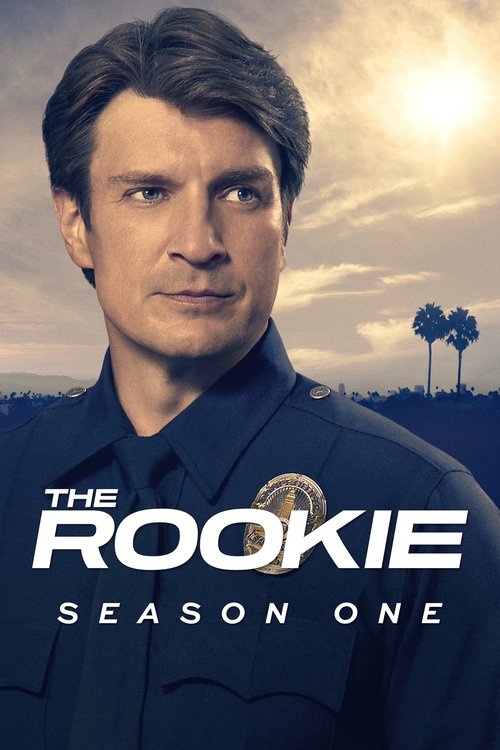
The Rookie
Season 1 Analysis
Season Overview
A life-changing incident pushes a 45-year-old man to chase his dream of becoming a cop. But he must prove himself to his LAPD superiors to make the cut.
Season Review
Categorical Breakdown
The main cast is structured as an intersectional hierarchy of competence where the white male protagonist (Nolan) and the abrasive white male Training Officer (Bradford) are frequently the least competent or most flawed characters, while the Training Officers who outrank Nolan are a Latina woman (Lopez) and a Black woman (Bishop), and the Captain is a Middle Eastern woman (Anderson). The only Black male rookie (West) is established as 'cop royalty,' but initially struggles with an extreme block, which is overcome through the guidance of his Latina female T.O. Lopez. The narrative emphasizes immutable characteristics by presenting the diverse group as superior or more grounded than their white male counterparts, though the plot's primary conflict is still merit-based (rookie survival).
The central premise validates the institution of the LAPD and American law enforcement as a whole, positioning the police as effective heroes and the necessary shield against chaos and terrorism. Sergeant Grey serves as the traditional, disciplined authority figure dedicated to upholding the police's high standards. Criticism is directed at individual bad actors or questionable tactics, such as T.O. Bradford using police authority to harass Mexican workers as a 'training exercise,' but the narrative's thrust is maintaining the honor of the police force, not tearing down the civilization or its institutions.
The female characters, particularly the training officers and the Captain, are consistently the most sharp, capable, and hyper-competent figures, occupying all positions of authority over the male rookies. Rookie Lucy Chen and T.O. Talia Bishop are career-focused and prioritize professional advancement over all else. The men (Nolan and Bradford) are largely defined by their mistakes, immaturity, or previous failures (e.g., Nolan's failed marriage, Bradford's drug-addict ex-wife), which positions the women as superior, independent 'Girl Boss' archetypes in a manner that subtly diminishes the male characters' authority and capability.
One of the three main rookies, Jackson West, is an openly gay character, placing the show beyond a strictly 'Normative Structure'. However, his sexual identity is a secondary characteristic; his main storyline revolves around overcoming his difficulty with using a firearm and living up to his father's expectations. The portrayal avoids a 'Queer Theory Lens' by not deconstructing the nuclear family, focusing on gender ideology, or centering his sexual identity as his most important trait. His romantic life is minimally featured in the first season.
The show is predominantly secular and procedural, focusing on legal and ethical adherence rather than any transcendent or spiritual moral law. It affirms an objective moral order (upholding the law, fighting crime) but does not root this morality in religious faith. Traditional religion is not featured as a source of strength, nor is it actively vilified or presented as the root of evil. This complete neutrality and reliance on secular humanist morality places the score in the middle of the spectrum.