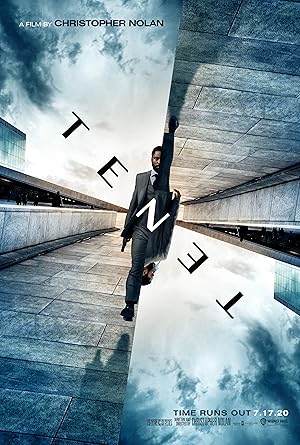
Tenet
Plot
In a twilight world of international espionage, an unnamed CIA operative, known as The Protagonist, is recruited by a mysterious organization called Tenet to participate in a global assignment that unfolds beyond real time. The mission: prevent Andrei Sator, a renegade Russian oligarch with precognition abilities, from starting World War III. The Protagonist will soon master the art of "time inversion" as a way of countering the threat that is to come.
Overall Series Review
Categorical Breakdown
The lead hero, The Protagonist, is Black, and his race is irrelevant to his character's competence, which suggests universal meritocracy. The casting choice itself is seen by some critics as a deliberate, colorblind choice for a 'Black Bond' archetype. The villain is a white Russian oligarch, Andrei Sator. The narrative does not utilize an intersectional lens or lecture on privilege; the focus remains strictly on the characters' abilities and their mission.
The central conflict is driven by future generations who have sent back the 'Algorithm' with the intent to destroy the past (the present) as revenge for the current generation's environmental and civilizational destruction of the planet. This incorporates the theme of self-hatred for one's own time and ancestors by framing the present as fundamentally corrupt or irresponsible toward the future. The heroes of Tenet are working to preserve the current timeline, counterbalancing this civilizational self-hatred.
The primary female character, Kat, is defined as a victim of domestic abuse by her husband, Sator. Her motivation is the maternal desire to free herself and her son from Sator's control. She is largely positioned as a 'damsel in distress' who motivates the male Protagonist's actions, a standard trope of the spy genre. She is not an instant 'Girl Boss' and her ultimate act of vengeance and self-liberation is strongly rooted in her role as a protective mother, which moves against an anti-natalist message.
The film focuses exclusively on normative structures. The relationships and character dynamics center on heterosexual marriage, parenthood, and male friendship. The narrative contains no characters who center their identity on alternative sexualities or gender ideology, and there is no attempt to deconstruct the nuclear family structure.
The movie operates within a secular, philosophical framework, centering on the concepts of time, fate, free will, and the 'mechanics of the world,' rather than traditional religion. The film does not explicitly attack or demonize traditional religion or Christian characters. The moral order is defined by a commitment to objective truth and a transcendent moral law (saving humanity), but the source of 'faith' is in the physics of the universe rather than a supernatural God, creating a spiritual vacuum without active hostility.