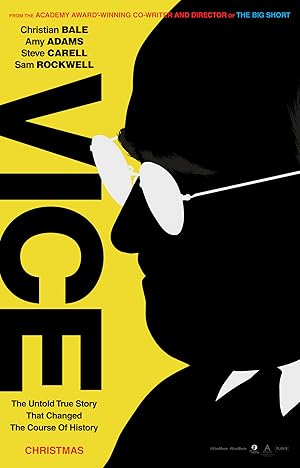
Vice
Plot
Governor George W. Bush of Texas picks Dick Cheney, the CEO of Halliburton Co, to be his Republican running mate in the 2000 presidential election. No stranger to politics, Cheney's impressive resume includes stints as White House chief of staff, House Minority Whip and defense secretary. When Bush wins by a narrow margin, Cheney begins to use his newfound power to help reshape the country and the world.
Overall Series Review
Categorical Breakdown
The film's vilification is focused on specific, powerful white males (Dick Cheney, George W. Bush, Donald Rumsfeld), characterizing them as incompetent, power-obsessed, or morally bankrupt opportunists. The critique is based on their political actions, ideology, and amoral nature, not on their immutable characteristics, keeping the score from reaching the highest level. George W. Bush is portrayed as a dim-witted and easily manipulated nonentity, while Dick Cheney is the highly competent, cold-blooded villain.
The film operates as an unambiguous condemnation of the Bush-Cheney administration, presenting a dark view of American institutions and their leadership. The Oval Office is framed as a nest of ambition, conspiracy, and betrayal, where amoral figures gain power and whose actions lead to disastrous global consequences, including the rise of a terror group and hundreds of thousands of deaths. This narrative frames a major segment of the home culture and its leadership as fundamentally corrupt.
Lynne Cheney is presented as the primary driver of Dick's ambition, a 'Lady Macbeth' figure who pushes her husband to greatness and calculates their political moves. She is portrayed as a shrewd, capable, and highly ambitious woman who uses the marriage as a vehicle for political fulfillment. Dick's rise is partly an effort to prove himself worthy to her, positioning her as a competent, dominant female figure in the relationship who spurs on the male's successful but destructive career.
The family conflict surrounding Cheney's lesbian daughter, Mary, is a central, recurring personal storyline used as a moral litmus test for Dick Cheney's character. The narrative strongly presents the acceptance of alternative sexuality as an inherent good against the father's political compromise. Cheney's eventual approval of his other daughter's public stand against same-sex marriage for political expediency causes a devastating family rift and is presented as a crucial moment of personal failure and moral decay.
The main antagonists are powerful political conservatives who are explicitly shown to be driven by an utter rejection of principles in favor of power. Donald Rumsfeld laughs at the notion of principles, implying that values are worthless and power is all that matters. The film explicitly describes Cheney as being 'bereft of an operating belief system,' framing his political success as directly tied to his embrace of moral relativism and his singular commitment to power accumulation.