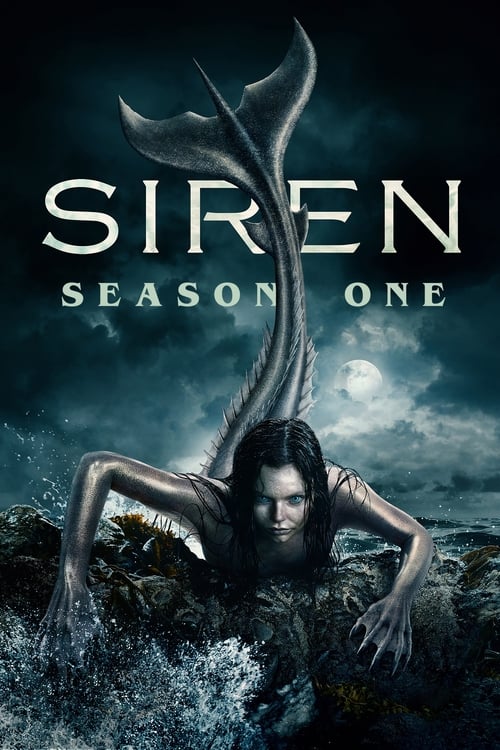
Siren
Season 1 Analysis
Season Overview
No specific overview for this season.
Season Review
Categorical Breakdown
The central conflict is an allegory of systemic oppression where the mermaids are an indigenous population facing 'genocide' at the hands of the white-dominated town and US military. The lead white male character, Ben, confronts his family's legacy which is built on the slaughter of mermaids. The narrative utilizes race-conscious casting, including Black mermaids (Donna) whose capture and torture by the government mirror historical abuses, reinforcing an intersectional victim/oppressor hierarchy.
The town of Bristol Cove, a clear representation of a small Western community, is revealed to have been built on a foundation of 'slaughter' and injustice against the mermaids. The main antagonists are the US government/military and the wealthy founding families of the town. The mermaid society is explicitly described by a human character as a 'slightly more advanced society,' portraying the Western home culture as fundamentally flawed, oppressive, and morally inferior.
The main mermaid, Ryn, is a powerful, nearly-flawless female predator whose raw violence is celebrated in key scenes, such as her killing of a male sexual harasser, which was framed by the creators as a 'cathartic' moment tied to the #MeToo movement. The narrative centers on the mermaids' 'empowered and strong' nature and their defiance of traditional human gender roles, positioning them as superior to the human male characters, who are often portrayed as either bumbling, toxic, or the victims of the more capable female leads.
The mermaid culture is presented as rejecting human gender differences and is described as being 'gender neutral and not binary,' with their sexuality not adhering to 'human-created gender norm[s].' This explicitly centers queer theory concepts. The core human relationship quickly absorbs Ryn, forming the foundation of a polyamorous dynamic, which deconstructs the traditional nuclear pairing as the standard.
The show promotes a subjective, predatory-based morality for the mermaids that is justified by their status as an oppressed group, which stands in contrast to objective moral truth. A direct discussion of historical Christianity frames it as puritanical and repressive regarding female sexuality. Traditional human institutions and historical moral frameworks are consistently undermined by the mermaids' 'superior' culture, creating a spiritual and moral vacuum in the human world.