Stranger Things
Season 2 Analysis
Season Overview
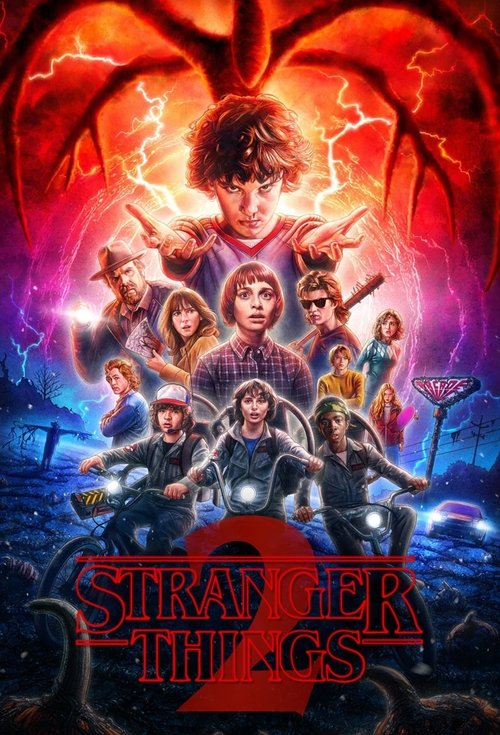
It's been nearly a year since Will's strange disappearance. But life's hardly back to normal in Hawkins. Not even close.
Season Review
Categorical Breakdown
The character Billy is introduced as an aggressive antagonist whose dialogue carries thinly veiled racist coding directed at Lucas, a Black main character, establishing a 'toxic white male' dynamic. The primary monster is described by a character through the analogy of Nazis who view other 'races' as inferior, using a real-world political atrocity to frame the conflict. The core heroes are still judged by their actions and courage, not their immutable characteristics.
Hostility is directed toward American institutions, specifically the corrupt and secretive Hawkins National Laboratory and its government-backed scientists, which are responsible for unleashing the chaos on the innocent town. The plot frames the American government and its obsession with power as the primary human villain. The town and its people are depicted as fundamentally good and worth defending, which acts as a counter-balance.
Female characters consistently demonstrate superior foresight and drive compared to the men. Joyce relies on her own instinct as a single mother to protect her son. Nancy and Eleven often have their warnings discounted or their actions questioned by the male characters before being proven correct. Nancy prioritizes pursuing justice for Barb over her relationship. The new female character, Max, is a competent, self-possessed tomboy who is initially resistant to the boys' rules. The character Mike is made abrasive and sidelined for much of the season.
The struggle of Will Byers is largely coded as an allegory for 'otherness' and struggling with one's identity, which is embraced by queer readings of the show. This subtext does not, however, become an overt political lecture, nor is a non-heterosexual identity centered as the most important trait for a major character; the normative male-female pairings remain the visible standard for the teenage characters.
The conflict is entirely secular, centered on scientific experiments, alternate dimensions, and human government conspiracy. The moral framework is purely humanistic, focusing on the power of community, friendship, and self-sacrifice to overcome evil. There are no traditional religious characters shown as positive influences or as villains, establishing a spiritual vacuum where the idea of Transcendent Morality is simply absent.