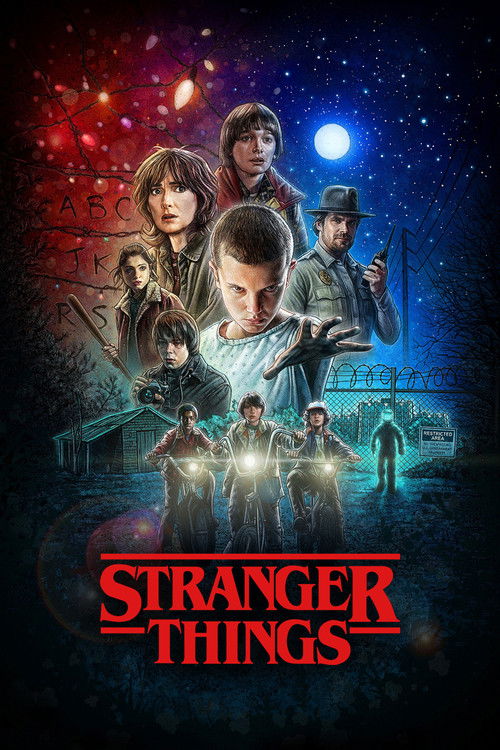
Stranger Things
Season 1 Analysis
Season Overview
Strange things are afoot in Hawkins, Indiana, where a young boy's sudden disappearance unearths a young girl with otherworldly powers.
Season Review
Categorical Breakdown
The children's group is multi-racial with Lucas Sinclair's presence, but the story is focused entirely on the character's merit, skill, and loyalty, not on their immutable characteristics. White males like Mike and Dustin are portrayed as intelligent and courageous leaders. The narrative contains no lecturing on privilege or systemic oppression based on race.
The town of Hawkins is presented as a stable, innocent American community. The narrative centers on defending this home, its families, and its social bonds from an external, metaphysical evil (the Upside Down) and a rogue, secret government institution. There is no deconstruction of local heritage or hostility toward the home culture.
Female characters drive the plot: Eleven is the super-powered child savior, Joyce Byers is the single mother whose fierce maternal instinct is the primary catalyst for the investigation, and Nancy Wheeler demonstrates resourcefulness and bravery by hunting the monster. This competency slightly raises the score. However, Joyce's heroism is rooted in celebrated motherhood, and male characters like Jim Hopper and Mike are also effective and heroic, preventing high scores for emasculation or anti-natalism.
The primary focus remains on traditional male-female pairings and the nuclear family unit (even if broken, as with the Byers). The only reference to an alternative sexuality is a character recounting a homophobic slur used against the missing boy Will, a line which is immediately dismissed by the mother who insists Will's being missing is the only thing that matters. There is no centering of sexual identity or political lecturing.
The series is secular, but it does not vilify religion. The supernatural threat is purely physical and scientific in its origin (a government experiment gone wrong). The conflict is a moral one between objective good (protecting the innocent) and objective evil (the Demogorgon and the corrupt scientists), a structure that acknowledges a higher moral law, despite the lack of religious imagery.