BoJack Horseman
Season 1 Analysis
Season Overview
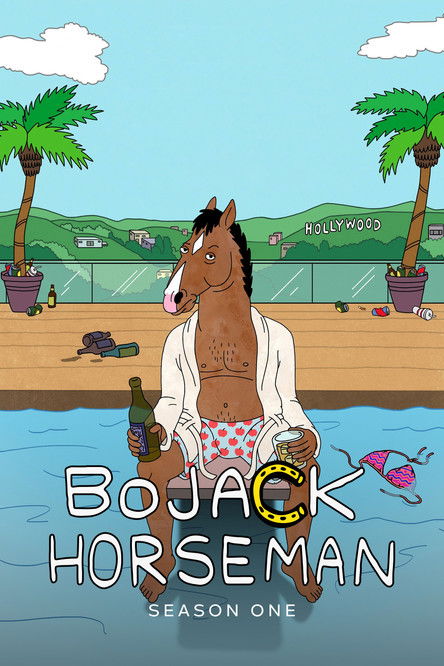
Once the star of the hit sitcom "Horsin' Around," today BoJack's washed up, just hanging around Hollywood complaining, and wearing colorful sweaters.
Season Review
Categorical Breakdown
The main cast features a human ghostwriter, Diane Nguyen, who is Vietnamese-American, and her high moral character contrasts with the toxic narcissism of the white male protagonist, BoJack. The former sitcom creator, Herb Kazzaz, is casually established as a gay man whose career was ruined by old Hollywood's bigotry, positioning him as a victim of institutional prejudice. The core conflicts center on personal moral failing and mental health rather than intersectional hierarchy, preventing a 10/10 score, but the clear moral superiority given to the minority and gay characters relative to the failed white male lead moves the needle substantially toward the high end.
The series focuses its criticism almost entirely on the specific, corrupt culture of 'Hollywoo' and the self-destruction of celebrity life. This is a critique of a localized American entertainment industry, not a wholesale demonization of Western civilization or the nation's heritage. The show's satire views the home culture as shallow, transactional, and morally vacuous, suggesting a fundamental internal corruption rather than an appreciation for its institutions or ancestors. This self-hatred is localized to the cultural elite, resulting in a moderate score.
The core male protagonist, BoJack, is portrayed as toxic, narcissistic, and reliant on his female agent, Princess Carolyn, and his female biographer, Diane, to manage his life and career. These female characters are highly competent, driven 'girl bosses' in their professional lives who are constantly cleaning up the male leads' emotional and professional messes. Diane actively challenges BoJack's moral worldview and seeks purpose, emphasizing professional/social fulfillment over traditional family structures. The consistent theme is the superiority of the women's competence and ambition against the men's bumbling or toxicity.
The main cast features Todd Chavez, who is coded as sexually aimless, and the significant character Herb Kazzaz is established as gay. Herb's narrative purpose involves him being a victim of institutional homophobia from the 90s, which establishes a historical critique of the nuclear family-oriented, heteronormative environment of the past. The presence of a core gay character whose background explicitly serves to indict past cultural norms, though done relatively subtly, moves the show past a '1/10' score, but the focus remains primarily on heterosexual relationships and general immorality.
The central theme revolves around an existential moral vacuum where characters constantly question if they are 'good people,' concluding that only their actions define them in a subjective universe. Diane explicitly states she does not believe in a 'deep down' good person, which is a key tenet of secular moral relativism: morality is a subjective product of behavior rather than a transcendent truth. The universe offers no spiritual solace or higher moral law, framing all moral discussion as a product of human action and psychology. This secular nihilism is a strong replacement for anti-theism, placing it at a high score for rejecting objective truth.