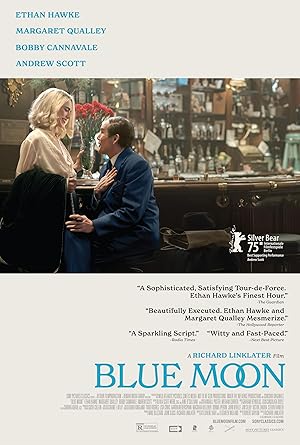
Blue Moon
Plot
Tells the story of Lorenz Hart's struggles with alcoholism and mental health as he tries to save face during the opening of "Oklahoma!".
Overall Series Review
Categorical Breakdown
The story centers on the struggles of a white male artist, Lorenz Hart, who is brilliant but profoundly self-destructive and insecure. The focus remains on his artistic genius and personal failings, not a critique of race or systemic oppression. Casting is historically accurate to the 1940s Broadway figures. Characters are judged by the content of their soul and professional talent.
The setting is a historically specific moment in American cultural history, 1943 Broadway, which the film treats with devotion. The main conflict is Hart's professional jealousy and his aesthetic contempt for the new, popular American musical, *Oklahoma!*, not a hostility toward Western civilization. No ancestors are demonized, and the institutions of family and nation are peripheral to the artistic drama.
The film is overwhelmingly male-centric, focusing on the relationships between male artists (Hart, Rodgers, Hammerstein, a young Sondheim) and a male bartender. The few female characters are minimal, and there is no evidence of a 'Girl Boss' or 'Mary Sue' trope. The narrative does not feature anti-natal or anti-family messaging, instead focusing on the protagonist's male-driven professional failure.
Lorenz Hart’s historically suppressed homosexuality is a core element of his tragic self-hatred and isolation shown in the film. The story explicitly references his 'hidden gayness' as a source of immense personal pain, centering a non-normative sexual identity. The portrayal is biographical and focuses on the emotional cost of being closeted in 1943, rather than a modern Queer Theory lecture or a deconstruction of the nuclear family.
The core of the film is the individual, personal struggle of a flawed artist with alcoholism and professional jealousy. There is no commentary, dialogue, or plot point that suggests hostility toward traditional religion, specifically Christianity. The thematic focus is on the failure of great art to redeem a broken soul, which is a moral question, not an anti-theistic one.