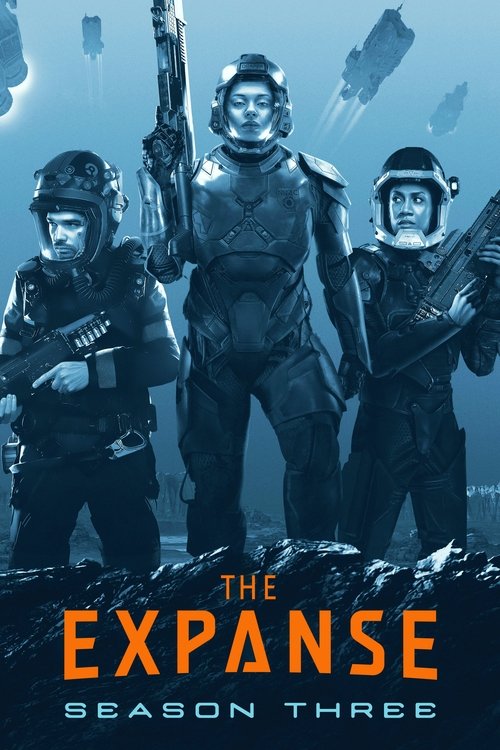
The Expanse
Season 3 Analysis
Season Overview
As the Rocinante crew digs deeper into the search for Prax's missing daughter, the war between Earth and Mars turns deadly in ways the solar system has never seen. But a new threat in the outer reaches of the Belt could prove much more dangerous, threatening to test the very future of humanity.
Season Review
Categorical Breakdown
The fundamental conflict pits the systemically oppressed working-class Belters (Beltalowda) against the powerful ‘Inners’ of Earth and Mars, framing the struggle as a class war based on immutable physical characteristics (Belters are tall, thin, and medically dependent on low gravity). The story relentlessly focuses on this socioeconomic/biological hierarchy and the structural power of the Earth/UN regime as an imperialist villain. Key figures of moral authority are predominantly non-white and/or Belter, while the chief architects of galactic war and protomolecule crimes are often powerful, old white males.
The governing institutions of Earth (the UN) are shown to be fundamentally corrupt, imperialistic, and driven by self-serving political ambition that nearly destroys the solar system. Mars is framed as a rigid, hyper-nationalist military state. The narrative positions the oppressed Belters and the crew of the Rocinante as the only viable moral anchors, critiquing the ancestral homes of humanity as irredeemably toxic. The Earth politician who commits war crimes is a leading official who views the Belters as subhuman.
Female characters hold near-total dominion over positions of power, strategy, and combat competence, embodying the 'Girl Boss' ideal. Chrisjen Avasarala is the galaxy's shrewdest political strategist; Bobbie Draper is an elite Martian Marine who is physically superior to almost any man; Naomi Nagata is the unrivaled technical and tactical genius; Camina Drummer is the unshakeable leader of the OPA flagship. A new female antagonist, Clarissa Mao/Melba, drives a complex assassination plot due to her own feelings of inadequacy and paternal neglect. The only significant male lead (Holden) spends much of the latter half of the season following the direction of a non-corporeal entity.
Alternative sexualities and gender theory are not a central theme of the season’s plot. The season does not include noticeable subplots or explicit lecturing to normalize or center alternative sexualities. The primary focus remains on the life-or-death political and protomolecule conflicts. Relationships are shown as private matters and are mostly traditional male-female pairings.
The Christian pastor Anna Volovodov is introduced as a major character, serving as a genuine moral compass who is highly intelligent, competent, and willing to challenge corruption on Earth. Her faith is a source of strength, not bigotry. However, the discovery of the Protomolecule and the Ring is treated purely as a scientific and material phenomenon, suggesting a universe governed by alien technology rather than a transcendent or objective moral law.