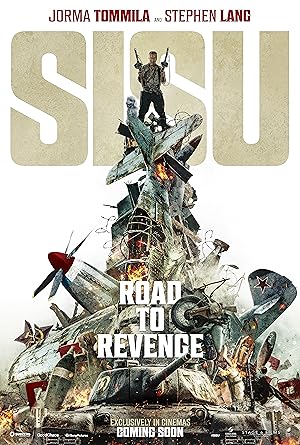
Sisu: Road to Revenge
Plot
A man returns to dismantle his family's house, where they were murdered in war, to rebuild it elsewhere. When the killer, a Red Army commander, tracks him down, a brutal cross-country pursuit begins.
Overall Series Review
Categorical Breakdown
The narrative is driven by revenge and national/personal survival, not by immutable characteristics or race. The protagonist is a white Finnish male, and the primary villain is a white Soviet Red Army officer. The conflict is purely based on the historical context of the Lapland War's aftermath and a personal quest for vengeance for the hero's family. The plot is the antithesis of a lecture on privilege, focusing on the character's extraordinary merit (his Sisu) to overcome impossible odds.
The film explicitly champions the defense and honoring of home and ancestry. The hero's main objective is to dismantle the home where his family was murdered and transport it to Finland to be rebuilt 'in their honor,' a clear act of gratitude toward his family and heritage. The villains are the invading Soviet Red Army, a force of foreign tyranny, not an internal critique of Finnish culture. The film leans into the mythology of the hero as a symbol of 'Finnish legend and history.'
The core dynamic is a brutal, masculine-coded survival and revenge tale between two men (hero and villain). The protagonist's entire motivation is the desire to honor his murdered wife and child (pro-family/pro-natal messaging). There is no indication of a 'Mary Sue' or 'Girl Boss' trope, nor any message that devalues motherhood or traditional male roles. The male hero is an exemplary figure of stoic, protective masculinity.
The plot is a simple, high-octane action-chase film set in a post-WWII war zone, focused on survival and personal revenge. The thematic material does not introduce any elements related to alternative sexualities, gender ideology, or a deconstruction of the nuclear family. The theme is absent and not relevant to the movie's core premise.
The movie operates on a clear, objective moral law where the hero (Korpi) is righteous and the villain (Draganov) is unequivocally evil, having murdered civilians and the hero's family. The morality is 'Transcendent' in the action genre sense—a pure Good vs. Evil confrontation. The hero's reputation is framed in almost mythic/spiritual terms (the 'man who refuses to die,' the 'legend'). There is no plot element dedicated to attacking religion, especially Christianity.