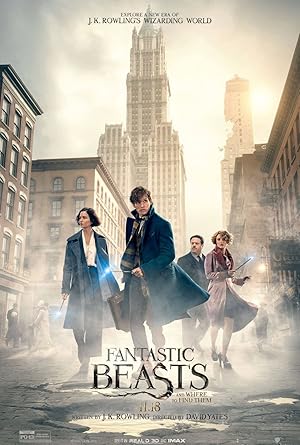
Fantastic Beasts and Where to Find Them
Plot
In mid-1920s New York, Newt Scamander, a British young activist wizard, arrives in the city, holding a mysterious leather suitcase that shelters diverse and magical creatures that exist among us. Amid an already fragile equilibrium of secrecy, and the increasing disasters ascribed to the dark wizard, Gellert Grindelwald, Newt's precious suitcase goes missing, and to make matters worse, several creatures manage to escape. Before long, this unforeseen complication catches Senior Auror Percival Graves' attention who targets Newt, against the backdrop of an invisible, devastating, and utterly unpredictable menace that still wreaks havoc on 5th Avenue. In the end, is there a hidden agenda behind Graves' intentions? Moreover, what will happen to the remaining fantastic beasts that are still on the loose?
Overall Series Review
Categorical Breakdown
The main conflict centers on the Obscurus, a devastating force born from a magical child being forced to suppress their innate identity due to societal fear, which functions as a clear allegory for systemic oppression and xenophobia. The highest authority figure, the President of the Magical Congress of the United States of America, is a Black woman in 1920s America, a detail that overrides historical authenticity to insert modern diversity into a position of ultimate power.
The American magical government (MACUSA) is presented as paranoid, incompetent, and driven by fear, nearly causing a disaster through its rigid, isolationist laws. Newt Scamander, the British protagonist, observes that American magical culture is 'backwards' compared to the British system. The primary non-magical antagonistic force, the New Salem Philanthropic Society, is depicted as a bigoted, puritanical reflection of corrupt American culture.
Female characters are consistently in positions of high power and moral competence. The head of the American wizarding world is the highly respected President Seraphina Picquery. Lead female protagonist Tina is a proactive, career-driven Auror, and her sister Queenie, though feminine, is powerful and essential to the team's success. The male lead, Newt Scamander, is an awkward, introverted figure who relies on the proactive nature of his female companions to accomplish his goals.
The core tragic plot point, the Obscurus that Credence harbors, functions as a clear metaphor for the suppression of a deeply-held, innate identity that must be hidden from a repressive society, a metaphor widely understood as representing the closeted queer experience. The main antagonist, Graves/Grindelwald, manipulates Credence with a dynamic that suggests a predatory relationship driven by the boy's repressed nature, further alluding to alternative sexualities through subtext and coding.
The main non-magical villains are the 'New Salem Philanthropic Society,' an explicitly puritanical, Christian-coded group whose anti-magic crusade is fueled by religious fundamentalism. The society's leader, Mary Lou Barebone, is shown to be abusive and cruel, with her religious-based repression directly creating the catastrophic dark force (the Obscurus) that threatens the entire city, making traditional religion the explicit root of widespread evil.