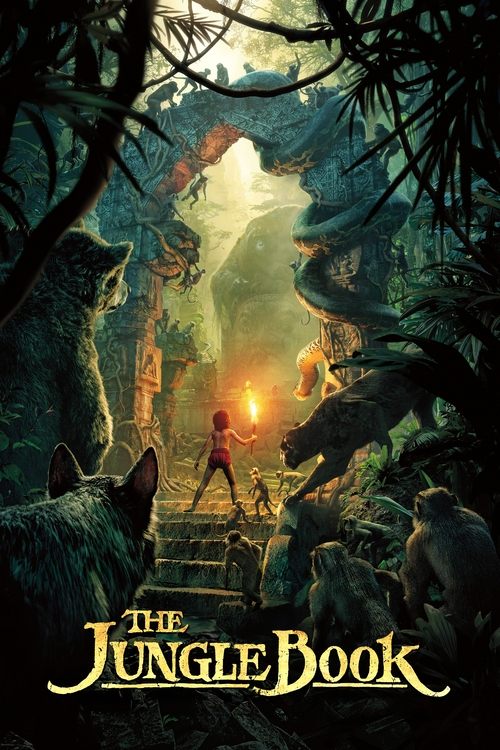
The Jungle Book
Plot
A man-cub named Mowgli fostered by wolves. After a threat from the tiger Shere Khan, Mowgli is forced to flee the jungle, by which he embarks on a journey of self discovery with the help of the panther, Bagheera and the free-spirited bear, Baloo.
Overall Series Review
Categorical Breakdown
The plot’s core conflict is not based on race or intersectional hierarchy; Mowgli is judged based on his species (“man-cub”) and his actions, aligning with a principle of meritocracy. The casting features an ethnically diverse cast, but the protagonist's identity is a universal struggle of man vs. nature, not an oppressed identity. The casting choices, particularly a black actor voicing the villain, can be read through a political lens, but this is not an explicit part of the narrative's central message.
The ending of the film explicitly rejects the path of human civilization. Mowgli refuses to enter the 'man-village' and instead chooses to stay in the jungle, using his ingenuity to uphold the Law of the Jungle. Man's chief tool, fire (the 'red flower'), is framed as a destructive force and a 'toxic behavior' that the protagonist must symbolically extinguish and reject in order to defeat the villain and save his home. This structure embodies the 'Noble Savage' trope, depicting the natural, non-human world as spiritually and morally superior to the destructive potential of human society.
The gender dynamics are overwhelmingly traditional. The most significant female character, Raksha the wolf mother, is portrayed as fiercely loyal and protective, embodying a celebration of motherhood. The only other speaking female character is the villainous python Kaa, who functions as a primal, sexualized temptress. There is an absence of 'Girl Boss' tropes and no anti-natal or anti-family messaging is present; the core family unit is a protective, traditional structure.
The narrative contains no overt sexual ideology. The film's primary themes are survival, identity, and courage, keeping the focus away from alternative sexualities or gender theory. The core family structure, the wolf pack, is a traditional male-female pairing with offspring, which is celebrated. The story is devoid of adult sexuality, save for the predatory nature of the villainous Kaa.
The moral framework of the film is built upon the natural 'Law of the Jungle' and personal virtue, such as courage, loyalty, and ingenuity. It is entirely neutral toward organized religion and contains no characters representing Christianity to vilify or attack. The film acknowledges a higher moral law in the form of the jungle's rules, focusing on objective truth within its own world structure.