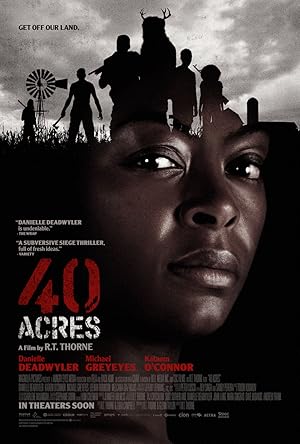
40 Acres
Plot
In a post-apocalyptic world with food scarcity, a Black family of Canadian farmers descended from American Civil War migrants defend their homestead against cannibals trying to seize their resources.
Overall Series Review
Categorical Breakdown
The plot's entire foundation and central conflict are built on immutable characteristics and historical grievance, setting a Black/Indigenous family defending their ancestral farm against roaming gangs of white thugs, or white cannibals, who are framed as extreme capitalists and fascists. The title itself is a direct lecture on the legacy of slavery and systemic oppression.
The film frames the societal collapse as a direct result of the West’s failures, specifically extreme capitalism and a dystopian political thought associated with white-power and anti-science neo-Christianity. This frames the broader Western civilization as fundamentally corrupt. The Freeman family’s specific heritage (descendants of US slaves who fled north) is celebrated as a superior, resilient bastion against this corruption.
Hailey Freeman is the dominant, authoritarian, and highly competent matriarch, running the farm with ex-military strictness and lethal skill. Her Indigenous male partner is supportive and secondary to her leadership role. The key male conflict is the son’s struggle against his mother's authority, positioning the woman as the unquestionable 'Girl Boss' figure of perfect survival capability.
The plot focuses entirely on the survival of a traditional, blended mother/father/children family unit. There is no information or evidence to suggest the presence of centering alternative sexualities or introducing queer theory themes into the narrative.
A critic directly links the societal collapse and the evil external forces to the impact of 'anti-science, White-power neo-Christian' political thought. This explicitly frames traditional religion as being associated with the failed, corrupt external world. The family's morality is pragmatic, based on military discipline and practical survival, not transcendent faith.