Zootopia
Plot
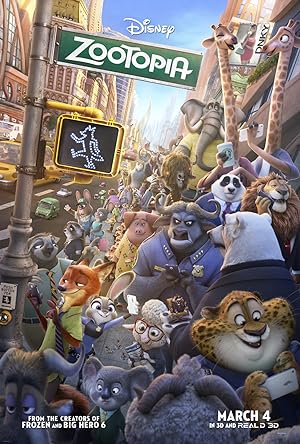
From the largest elephant to the smallest shrew, the city of Zootopia is a mammal metropolis where various animals live and thrive. When Judy Hopps becomes the first rabbit to join the police force, she quickly learns how tough it is to enforce the law. Determined to prove herself, Judy jumps at the opportunity to solve a mysterious case. Unfortunately, that means working with Nick Wilde, a wily fox who makes her job even harder.
Overall Series Review
Categorical Breakdown
The film's central metaphor of predator-vs-prey is a direct and explicit allegory for race, class, and systemic oppression. The plot exists to dramatize microaggressions, stereotyping, and institutional bias, particularly the experience of a minority group (small prey/foxes/predators) in a majority-dominated (large mammals/prey) society and institution. The villain's plan is to exploit fear and prejudice to maintain power, framing the narrative as a lecture on how societal prejudice is leveraged by the powerful (a key theme of systemic oppression and 'power dynamics'). Judy Hopps is marginalized due to her immutable characteristic (species/size) and must constantly prove her merit against a prejudiced system.
Zootopia, the advanced metropolis and representation of modern, liberal civilization, is revealed to be a false utopia built on a fragile social contract and deep-seated, institutionalized prejudice and fear. The film's central conflict critiques this sophisticated 'home culture' as corruptible and flawed at its foundation, demanding radical correction from the protagonist who leaves the ancestral farm life. This focus on the corruption inherent in the modern civic structure scores high, though it is not a complete condemnation of all ancestors or institutions, which saves it from a 10/10.
The protagonist, Judy Hopps, is a classic 'Girl Boss' figure who challenges a male-dominated institution (the Police Department), facing explicit sexism and being underestimated by large, masculine-coded authority figures (like Chief Bogo). Her arc is driven by breaking gender/species norms ('a bunny can't be a cop' / 'get back on the carrot farm where you belong'), directly aligning with the 'Girl Boss' trope of female excellence in a traditionally male field. Male characters are initially bumbling (Flash the sloth) or cynical/morally compromised (Nick Wilde), though Nick's redemption provides a complementary partnership rather than complete emasculation, preventing a perfect 10.
The 2016 movie contains no overt LGBTQ+ representation, centering alternative sexualities, or lecturing on gender theory. The relationships are heteronormative by default (Judy and Nick's bond, Judy's mother and father). Background characters or the inter-species relationships are sometimes interpreted allegorically by critics to represent same-sex relationships, but this interpretation is not an explicit narrative focus of the film itself, resulting in a low score.
The movie is secular, with no explicit reference or hostility toward any specific religion, including Christianity. The moral message centers on personal virtue, forgiveness, and judging individuals by their character rather than their group, which is a form of objective moral law and has been interpreted by Christian reviewers as aligning with traditional values. The narrative focuses on social and political corruption, leaving the spiritual realm entirely untouched, thus scoring very low on 'Anti-Theism'.