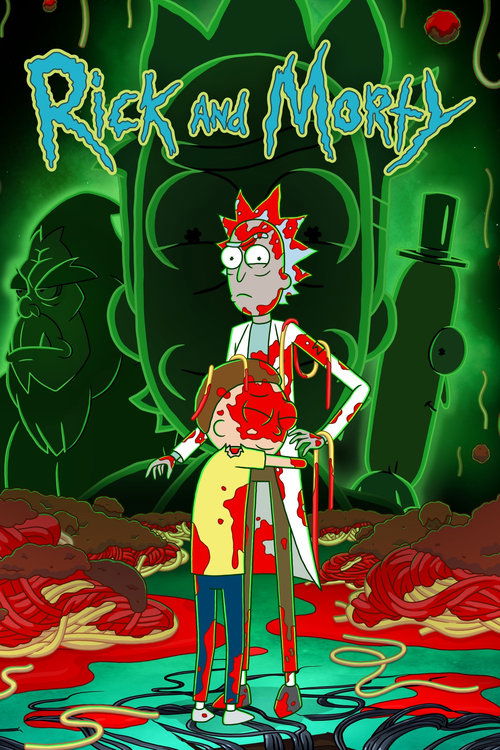
Rick and Morty
Season 7 Analysis
Season Overview
Rick and Morty are back and sounding more like themselves than ever! It's season seven, and the possibilities are endless: what's up with Jerry? EVIL Summer?! And will they ever go back to the high school?! Maybe not! But let's find out! There's probably less piss than last season. "Rick and Morty," 100 years! Or at least until season 10!
Season Review
Categorical Breakdown
The narrative does not rely on race or intersectional hierarchy for plot or character definition. Characters are judged almost entirely by their competence, merit, and emotional maturity, with Rick's arc focusing on overcoming his personal trauma rather than systemic issues. The main cast is largely the traditional white Smith family. The season does feature minor meta-jokes that reference real-world political divides in passing, but these are not the core of the story.
The series' foundational premise involves cynicism toward all existing structures, treating government, institutions, and sometimes the nuclear family as inherently absurd, chaotic, or contemptible. An episode critiques the 'corporation of suffering in society,' and another features an omniscient auditing institution that is exposed as hypocritical and abusive. Rick's emotional arc provides a measure of respect for his personal family and lost heritage, but the overall world view is hostile toward the value of human societal constructs.
Female characters like Beth and her variant 'Space Beth' are consistently portrayed as highly capable, independent, and career/adventure-focused, embodying a 'Girl Boss' archetype, with Space Beth being an adventurous, accomplished figure. Jerry, the primary male head of the household, remains the show's perpetual punching bag, often depicted as bumbling and incompetent. Beth’s storylines continue to explore her complex identity outside the traditional mother and wife roles. One episode shows Rick's ex-girlfriend, an alien hivemind named Unity, successfully taking over a state and transforming it into a utopia, making her a highly competent, albeit non-traditional, female force.
The core family unit continues to feature the polyamorous relationship dynamic between Beth, her clone Space Beth, and Jerry. The narrative explores this arrangement as a facet of their complex identity issues and relationship struggles. While the show presents this non-traditional arrangement as a viable, albeit chaotic, part of the main characters' lives, it is not framed as an explicit political lecture or used to deconstruct gender identity, keeping the score moderate.
The score is high because of an explicit episode plot that ridicules a major religious figure (The Pope) and attempts to exploit the power source of the afterlife. The show’s depiction of the afterlife is purely secular and mechanistic, with 'mind energies' aggregating according to 'individual beliefs,' which serves as a complete materialistic deconstruction of spiritual faith. Rick's core worldview throughout the season remains a highly articulate nihilism and moral relativism, consistently rejecting the notion of objective truth or a higher moral law.