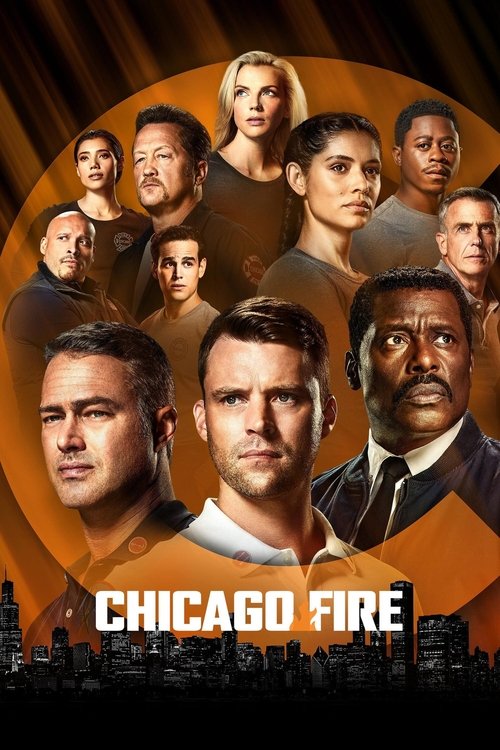
Chicago Fire
Season 10 Analysis
Season Overview
Milestones and transitions mark a new chapter for Firehouse 51. As the team faces the unknown, legacy and loyalty remain at the heart of every call.
Season Review
Categorical Breakdown
Character casting is aggressively diverse, including a Black Deputy District Chief (Boden), a Black gay firefighter (Ritter), and a Japanese-American paramedic (Mikami). A subplot centers on Joe Cruz and his wife adopting a young immigrant boy, giving a favorable lens to the immigrant experience. Another storyline focuses on recruiting a new firefighter with a criminal record, which prioritizes second chances over strict prior meritocracy, though competence is ultimately demonstrated. The narrative, however, stops short of explicit vilification of white men as a class, focusing instead on individual competency and honor for all characters, including white males like Severide and Herrmann.
The series fundamentally respects and celebrates the Western institution of the fire department and the city of Chicago's first responders. The characters view Firehouse 51 as a protective shield and an extended family. Conflicts with 'the system' are generally targeted at individual corrupt or bureaucratic 'brass' (e.g., a superior officer's political maneuvering or a rival paramedic’s unethical tactics) rather than framing the city or the fire service itself as fundamentally racist or corrupt. Gratitude for the firehouse community is a central theme.
Female characters are highly promoted and focused on career advancement. Stella Kidd achieves a Lieutenant rank, and Sylvie Brett successfully launches a paramedicine program, which aligns with the 'Girl Boss' trope of career fulfillment. However, Stella's struggles with balancing her ambition and personal life and a new paramedic character being depicted as a toxic, hyper-ambitious villain (Emma Jacobs) somewhat complicates the 'perfect female lead' archetype. The show presents a balance, celebrating career women while also depicting a stable, traditional wedding (Severide/Kidd) and celebrating the adoption/family building (Cruz/Chloe), avoiding strong anti-natalism.
The main cast includes Darren Ritter, an openly gay Black firefighter, whose relationship with his boyfriend, Eric, is a consistent, positive, and normalized plot point throughout the season. This integration moves the score past a 'private sexuality' level as it is a recognized part of a main character's life and development. However, the season avoids lecturing on gender ideology and maintains the traditional male-female pairing as the standard for major relationships (Severide/Kidd, Brett/Casey, Cruz/Chloe), preventing a higher 'Queer Theory' score.
There is a plot line involving an arsonist who targets a church. In this story, the church is a victim, positioning the religious institution as a force of neutral or positive communal value that is being attacked by a villain. No characters are depicted as evil or bigoted *because* of their Christian faith, nor is moral relativism strongly embraced. The core morality of the show is transcendent, revolving around the absolute good of selfless service and saving human life.