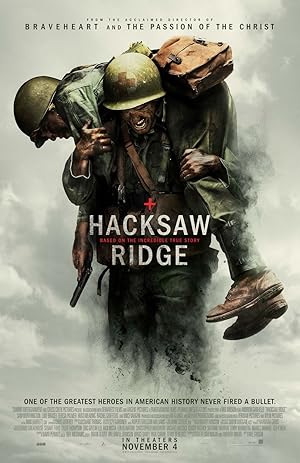
Hacksaw Ridge
Plot
The true story of Desmond T. Doss, the conscientious objector who, at the Battle of Okinawa, was awarded the Medal of Honor for his incredible bravery and regard for his fellow soldiers. We see his upbringing and how this shaped his views, especially his religious view and anti-killing stance. We see Doss's trials and tribulations after enlisting in the US Army and trying to become a medic. Finally, we see the hell on Earth that was Hacksaw Ridge.
Overall Series Review
Categorical Breakdown
The plot focuses entirely on the spiritual conviction of the white male protagonist, Desmond Doss, who is judged by the content of his soul and his heroic actions, not by his immutable characteristics. Doss is a virtuous and courageous hero. His white peers initially persecute him but ultimately respect him based on his merit and bravery under fire. The casting is historically authentic to 1940s Virginia and the WWII US Army.
Desmond Doss is portrayed as a deep patriot who enlists in the Army because he believes it is his duty to serve his nation, explicitly contradicting civilizational self-hatred. The film honors the sacrifices of American soldiers during a major historical conflict. The institutions of the military and his Christian faith are framed as a source of strength, duty, and moral order.
The primary female role, Doss’s sweetheart Dorothy, is a nurse whose primary function is to represent the peace, home, and love Doss is fighting to return to, providing emotional support and spiritual grounding. Masculinity is shown to be protective and defined by self-sacrifice and love, in opposition to the drunken rage of Doss’s father. Marriage and the nuclear family are foundational elements of the hero’s life that he strives to protect.
The narrative contains no LGBTQ+ characters or themes. The only major romantic relationship is the courtship and marriage between Desmond and Dorothy. The structure of the family unit is exclusively traditional, and no sexual or gender ideology is present in the plot or dialogue.
Faith is the explicit and central source of the protagonist's extraordinary moral and physical courage, as he saves his comrades while praying for the strength to 'save just one more.' Doss's religious conviction (Seventh-day Adventist) is portrayed as a transcendent moral law that guides his actions, and his faith is ultimately validated and rewarded with honor and the respect of his peers.