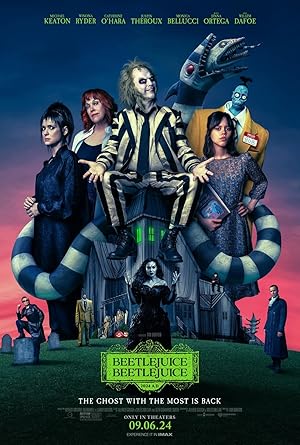
Beetlejuice Beetlejuice
Plot
From critically acclaimed filmmaker and screenwriter, Tim Burton presents the long-awaited sequel to the Halloween classic. Keaton's action-packed comedic demon returns to the silver screen for more mischief than ever before. When the Maitland house EXPLODES, so does the fun, so buckle up. The original cast and crew plus new additions return when Beetlejuice is found homeless in the netherworld. He takes it upon himself to travel back to the mortal world seeking comfort, only to find the Maitland house has blown up due to a gas leak. Leaving our beloved characters without a humble home to share the love. In search of guidance, the crew travels down to the Netherworld only to find there's a new sheriff in these parts, The Jersey Devil (Will Arnett). Through a surprising turn of events, the self-known ladies man, Beetlejuice learns that the Jersey Devil is his long-lost son through one of his numerous love affairs. Lydia Deetz (Winona Ryder) is wood by the enchanting Jersey Devil, despite being married to a struggling real estate agent (David Harbour). Through kooky scenarios and ecstatic characters, the fun near stops. Though entertaining it is also a heart-wrenching tale that shows Beetlejuice is just another man trying to find his way in the world. The story also progresses the idea that a family is never truly ideal. The story continues when you say the release date three times unbroken. Release date TBD.
Overall Series Review
Categorical Breakdown
The story centers on a returning, largely white cast and new characters defined by their familial connections and demonic or supernatural status. Characters are judged by their chaotic nature and actions, not by immutable characteristics. There is no element of vilifying whiteness or introducing forced diversity; the focus is on the Deetz family and the Netherworld's inhabitants.
The literal destruction of the family home through an accident, leaving the characters without a 'humble home,' deconstructs the traditional symbol of stability. The action quickly moves to the Netherworld, a chaotic and non-normative realm. This continues the franchise's tradition of anti-suburban, anti-establishment themes, but it stops short of demonizing ancestors or framing Western civilization as fundamentally corrupt.
Lydia Deetz, a prominent female lead, is successfully courted by the 'enchanting' Jersey Devil despite being married. Her husband is depicted as a 'struggling real estate agent,' a narrative contrast that emasculates the stable male figure. The story concludes by explicitly stating that a family is 'never truly ideal,' which actively pushes an anti-traditional family message.
The core relational drama focuses on a heterosexual triangle involving a married woman, her husband, and a male demon. The conflict is driven by attraction and infidelity. The structure is entirely normative with regard to sexual pairing and the nuclear family, albeit a highly dysfunctional and non-ideal one. There is no explicit presence of sexual ideology or political lecturing.
The entire setting of the Afterlife, ruled by demons and featuring a chaotic Netherworld bureaucracy, operates as a spiritual vacuum, subverting traditional Christian or transcendent moral laws. The film embraces moral relativism in a comedic, chaotic way. It does not contain specific attacks or villainizing of religious characters, instead treating the afterlife as an absurd, secular bureaucracy.