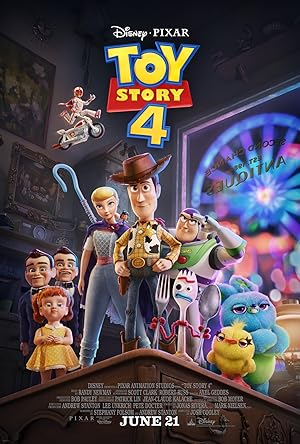
Toy Story 4
Plot
Woody, Buzz Lightyear and the rest of the gang embark on a road trip with Bonnie and a new toy named Forky. The adventurous journey turns into an unexpected reunion as Woody's slight detour leads him to his long-lost friend Bo Peep. As Woody and Bo discuss the old days, they soon start to realize that they're two worlds apart when it comes to what they want from life as a toy.
Overall Series Review
Categorical Breakdown
The movie’s conflict is driven by 'identity' in the sense of 'self-defined purpose,' most notably with Forky struggling to accept that he is a toy instead of trash. This arc is seen by some as a metaphor for self-identification and rejecting externally imposed labels. Woody, the traditional white male lead, is initially depicted as attempting to enforce the 'traditional' definition of what a toy is. However, the plot does not rely on race or intersectional hierarchy for its main conflict, focusing instead on a philosophical debate about purpose. Casting includes a new toy voiced by a black comedian and his sidekick, but the overall presentation is not a lecture on systemic oppression.
The central dramatic resolution involves Woody rejecting his domestic life with a child, which the previous trilogy framed as the ultimate good and purpose. Bo Peep, his romantic interest, explicitly rejects the 'gilded cage' of being a child's toy, promoting a rootless, independent life outside the home as superior. The narrative successfully convinces Woody to abandon his long-standing institutional duty to a child and his family (the 'civilizational' anchor of the series) to pursue a life of self-chosen freedom and adventure with her, fundamentally deconstructing the series' heritage and previous moral framework.
The character of Bo Peep is dramatically reinvented into an empowered 'Girl Boss' figure. She sheds her traditionally feminine shepherdess dress for an action-ready pantsuit and uses her staff as a weapon. She is portrayed as a superior and more competent operator than Woody, successfully leading rescue missions and demonstrating self-sufficient bravery. Woody is repeatedly out-of-touch, passive, or incompetent without her guidance. Her final decision to permanently reject her role as a toy for a child—the epitome of an anti-natal/anti-domestic choice—serves as the catalyst for Woody's own 'liberation,' making her independence the aspirational model for both characters.
The movie includes a brief, non-plot-relevant scene in the background of a kindergarten classroom where a child is dropped off and picked up by two women who are clearly a same-sex couple. This subtle inclusion serves as a method of normalising the deconstruction of the nuclear family within family-friendly entertainment, though it does not center the sexual identity of the characters. There is no direct lecturing or gender ideology present, keeping the score low relative to the definition's extreme pole.
The film resolves its conflict by embracing moral relativism and a spiritual vacuum centered on individual self-will. Woody’s former purpose was a transcendent moral law—a toy exists to be there for its child—but he chooses to discard this objective 'design' in favor of a self-determined, arbitrary, and subjective 'inner voice.' The movie’s main theme is that meaning is found through personal liberation and self-creation rather than fulfilling a pre-ordained destiny or duty. This aligns with the idea that no higher moral law exists outside of personal preference and choice.