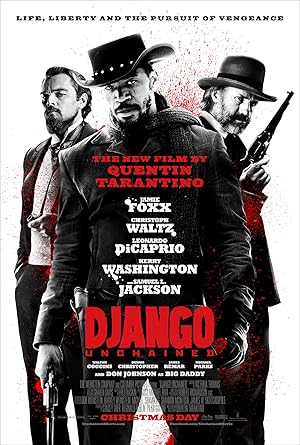
Django Unchained
Plot
In 1858, a bounty-hunter named King Schultz seeks out a slave named Django and buys him because he needs him to find some men he is looking for. After finding them, Django wants to find his wife, Broomhilda, who along with him were sold separately by his former owner for trying to escape. Schultz offers to help him if he chooses to stay with him and be his partner. Eventually they learn that she was sold to a plantation in Mississippi. Knowing they can't just go in and say they want her, they come up with a plan so that the owner will welcome them into his home and they can find a way.
Overall Series Review
Categorical Breakdown
The entire plot exists as a lecture on systemic oppression and a fantasy of retribution against a race-based hierarchy. The narrative relies entirely on race and immutable characteristics to define the moral alignment of nearly every character. The primary villains are the white male plantation owners, depicted as pure evil, sadistic, and often incompetent outside of their racial privilege.
The film presents the Antebellum South, a specific American civilization and its associated heritage, as fundamentally and irrevocably corrupt. Institutions related to this culture, such as the plantation and proto-Ku Klux Klan groups, are demonized and violently deconstructed. The narrative posits the violent eradication of this home culture's representatives as an ultimate good.
Gender roles are overwhelmingly traditional, centered on a male protagonist motivated by the vital bond to his wife, the classic 'damsel in distress' trope. The plot is a quest for martial love and family reunification. The female lead is defined by her captivity and rescue, opposing the 'Girl Boss' trope.
The film operates entirely within the normative structure of a male-female pairing as the central, heroic relationship. Alternative sexualities and gender ideology are absent from the narrative. No political lecturing on sexual or gender identity occurs.
The society being violently overthrown is a 'Christian' slave-holding one, and the film clearly exposes the profound moral hypocrisy of the oppressors. However, the film itself does not directly critique God or all faith as the root of evil. The protagonist's final acts of violent revenge frame morality as subjective retribution against the power dynamics of the slave system rather than adherence to a higher, objective moral law.