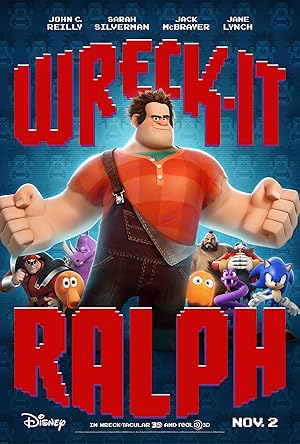
Wreck-It Ralph
Plot
Wreck-It Ralph longs to be as beloved as his game's perfect Good Guy, Fix-It Felix. Problem is, nobody loves a Bad Guy. But they do love heroes... so when a modern, first-person shooter game arrives featuring tough-as-nails Sergeant Calhoun, Ralph sees it as his ticket to heroism and happiness. He sneaks into the game with a simple plan -- win a medal -- but soon wrecks everything, and accidentally unleashes a deadly enemy that threatens every game in the arcade. Ralph's only hope? Vanellope von Schweetz, a young troublemaking "glitch" from a candy-coated cart racing game who might just be the one to teach Ralph what it means to be a Good Guy. But will he realize he is good enough to become a hero before it's "Game Over" for the entire arcade?
Overall Series Review
Categorical Breakdown
Characters are judged by their assigned video game roles, such as 'Bad Guy' or 'Glitch,' which creates a story about overcoming prejudice and earning respect through character merit, not on immutable characteristics like race or a socio-political power hierarchy. Ralph’s ultimate acceptance by his community is based on his heroic actions and personal growth.
The central dramatic tension involves preserving the stability and existence of the arcade and the individual game worlds. The villain is an envious force who threatens the entire established 'home' and its diverse cultures. The narrative encourages gratitude and protection of the existing system, opposing its chaotic destruction.
The movie includes two prominent female protagonists, Vanellope von Schweetz and Sergeant Calhoun, who are defined by exceptional skill, fearlessness, and competence. Calhoun is a hyper-masculine military leader who marries the more gentle, traditionally 'good' male character, Fix-It Felix, subverting traditional gender roles. The female characters are strong but are not portrayed as instantly perfect, nor is the male character universally emasculated, though his competence is repeatedly contrasted with Calhoun's.
The main relationships are a platonic, father-figure dynamic between a male and female character (Ralph and Vanellope) and a traditional male-female romantic pairing (Felix and Calhoun). The film does not feature or center alternative sexualities or gender identity ideology. Sexuality is not a theme.
Religious themes are entirely absent from the story. The moral framework is centered on objective concepts of self-sacrifice, true friendship, and saving an innocent world from an external, selfish evil. Characters learn a transcendent moral truth that inner goodness is more important than external labels.