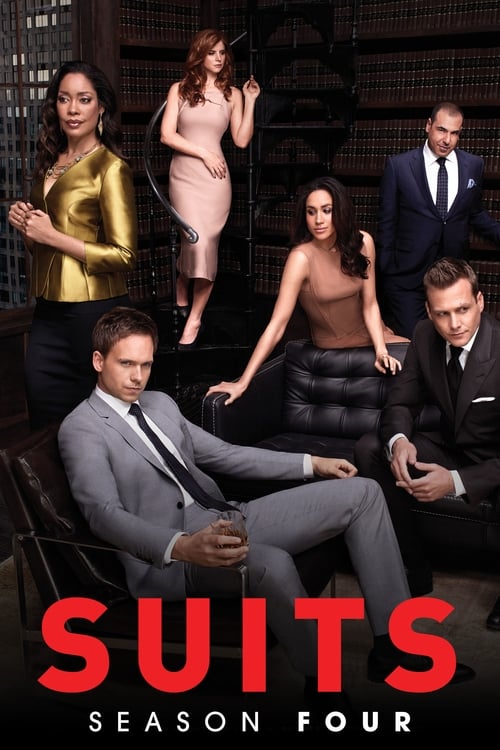
Suits
Season 4 Analysis
Season Overview
In Season 4, Harvey and Mike find themselves on opposite sides of a corporate takeover battle that draws attention from the government.
Season Review
Categorical Breakdown
The main narrative is driven by professional ambition, personal loyalty, and a secret legal fraud, not by race or immutable characteristics. Jessica Pearson, a Black female character, holds the ultimate position of authority as the firm's Managing Partner, a role she earned through merit and ruthlessness. All main characters, including white males like Harvey and Louis, are depicted as equally flawed and competent based on their actions, not their identity.
The series is a celebration of the ambitious, high-stakes, hyper-capitalist world of New York corporate law. The characters constantly strive for success, wealth, and power within established Western institutions. The central conflict involves fighting for control of a major American corporation, which places high value on the institutions themselves. There is no deconstruction of heritage or framing of the home culture as fundamentally corrupt due to its Western nature.
Female characters like Jessica Pearson, Donna Paulsen, and Rachel Zane are consistently portrayed as powerful, highly competent, and essential to the firm's operation, leaning toward the 'Girl Boss' trope. Jessica is the unquestioned head of the firm. One minor plotline features a main female character (Sheila) prioritizing her career over having children, which becomes a direct, dramatic reason for a relationship's failure. However, the male characters (Harvey, Louis, Mike) are not generically depicted as toxic or incompetent, but as flawed high achievers.
The core relationships and character drama focus entirely on traditional male-female pairings. A love triangle is a central emotional conflict for two main characters, which involves a straight ex-boyfriend. There is no presence of alternative sexual ideologies, centering of non-heteronormative identities, or lecturing on gender theory.
The setting is a secular corporate environment where the law is treated as a weapon for personal and professional gain, leading to rampant moral relativism and highly unethical behavior by nearly all main characters. Morality is subjective and determined by 'how far you are willing to go.' This operates in a spiritual vacuum, but the show does not include any explicit hostility toward or vilification of organized religion, particularly Christianity.