The Boys
Season 5 Analysis
Season Overview
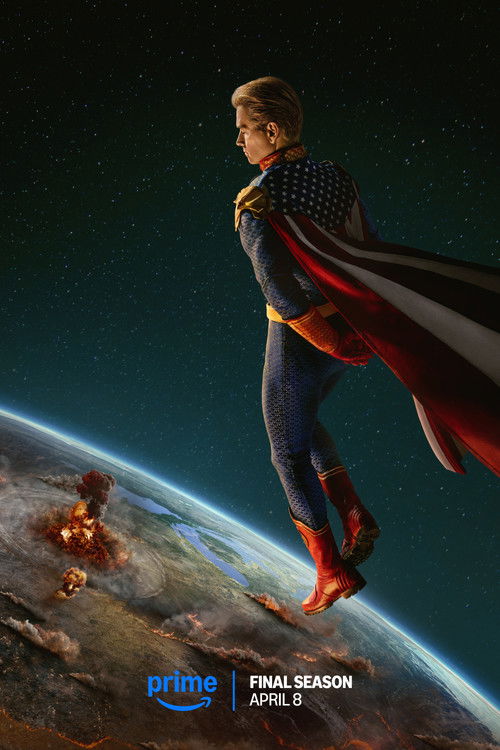
It’s Homelander’s world, completely subject to his erratic, egomaniacal whims. Hughie, Mother’s Milk, and Frenchie are imprisoned in a “Freedom Camp.” Annie struggles to mount a resistance against the overwhelming Supe force. Kimiko is nowhere to be found. But when Butcher reappears, ready and willing to use a virus that will wipe all Supes off the map, he sets in motion a chain of events that will forever change the world and everyone in it.
Season Review
Categorical Breakdown
The plot directly centers on a struggle against systemic oppression, with the primary villain, Homelander, being the epitome of toxic, hyper-conservative, white, male, American power. The entire narrative is a lecture on the systemic nature of power and privilege, where the powerful elite (Supes) persecute political dissidents based on ideological alignment, explicitly drawing lines of intersectional hierarchy.
The narrative frames the core home culture—the United States and its institutions—as fundamentally corrupt, having completely failed and fallen to a fascist regime that operates under the guise of patriotism and American exceptionalism. The establishment of 'Freedom Camps' for political enemies confirms the nation's governing structure has become thoroughly poisoned and hostile toward its own people, leaving nothing for the heroes to defend but chaos.
The female protagonist, Starlight (Annie), is positioned as the main, non-compromised leader of the entire resistance movement, while the male protagonists, Hughie, Mother’s Milk, and Frenchie, begin the season incapacitated in prison. The main male anti-hero, Butcher, continues on his path of extreme nihilism and moral failure, reinforcing the trope where the toxic male is incompetent or actively dangerous, while the female lead must shoulder the burden of pure, principled leadership.
The show continues its trend of using alternative sexualities as a moral litmus test. The struggle against Homelander's authoritarian regime implies that the fight for tolerance and sexual liberation is central to the resistance's principles. The villainous, conservative-coded power structure is presented as the enemy of sexual freedom, while the heroes, who have historically embraced alternative sexualities, are the defenders of those identities.
Homelander's entire public persona and his corporation, Vought, are built on a commercialized and hypocritical appropriation of Christian iconography and values, positioning traditional religion as a tool of oppression and tyranny. The Christian-aligned segment of the population and political base is consistently aligned with the central, evil, all-powerful enemy. No religious belief or transcendent morality is presented as a genuine source of strength for the heroic characters.