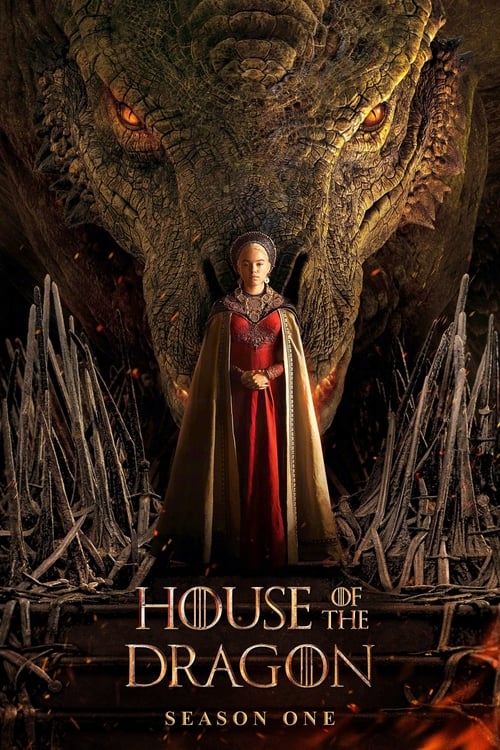
House of the Dragon
Season 1 Analysis
Season Overview
Set nearly 200 years before Game of Thrones, this season chronicles the events leading up to the Targaryen civil war, known as the Dance of the Dragons. King Viserys I Targaryen names his daughter, Princess Rhaenyra, as heir to the Iron Throne, breaking tradition and igniting tensions within the realm. The court becomes divided as Queen Alicent Hightower, Viserys’s second wife, promotes her son Aegon’s claim to the throne. Political intrigue, shifting alliances, and personal betrayals set the stage for a looming conflict that threatens to tear the Targaryen dynasty apart.
Season Review
Categorical Breakdown
The Velaryon noble family is 'race-swapped' from their original pale-skinned, Valyrian description to Black characters, which the creators stated was an intentional move to rectify the lack of diversity in the prior series. This artistic decision prioritizes identity quotas over the source material's established physical traits, an act of forced diversity. The casting subsequently impacts the narrative by making the illegitimacy of Princess Rhaenyra’s white children with her Black husband visually unmistakable. There is a clear tendency to portray the powerful white male characters as either weak, incompetent, or morally corrupt.
The central thematic premise is that the entire Westerosi civilization is fundamentally flawed, defined by its 'patriarchal feudal system' which is the source of all the characters' misery and the coming civil war. This framing casts the foundational culture and institutions as fundamentally corrupt. Additionally, the show hints at the 'Maester Conspiracy,' portraying the Citadel, a key Western-equivalent scholarly institution, as a secret organization actively working to undermine the Targaryen dynasty and eliminate magic/dragons from the world.
The narrative is a constant, explicit commentary on systemic misogyny, making the world's patriarchy the primary villain that drives the plot and character development. Graphic, brutal childbirth scenes are repeatedly included, framing motherhood as a life-threatening sacrifice or 'prison' used to generate pity and highlight the injustice of the world. Male characters, including the King, are routinely depicted as weak-willed, incompetent, or overtly toxic.
A high-ranking political marriage between Princess Rhaenyra and Ser Laenor Velaryon is immediately characterized by the husband’s open homosexuality. The couple's arrangement to take separate lovers explicitly deconstructs the nuclear family unit at the highest level of the realm. Centering alternative sexualities in a plot-critical way that affects the royal line of succession places this theme in a prominent position.
The Faith of the Seven, the show’s equivalent of traditional Western religion, is primarily shown through Queen Alicent, who adopts it as a public shield of morality. This display is repeatedly presented as a 'shallow veneer' used to justify her political ambitions and fanatical, hypocritical actions. The morality of the characters is framed in shades of gray, consistent with a subjective, 'power dynamics' view of right and wrong rather than a transcendent, objective moral law.