Kamen Rider
Season 5 Analysis
Season Overview
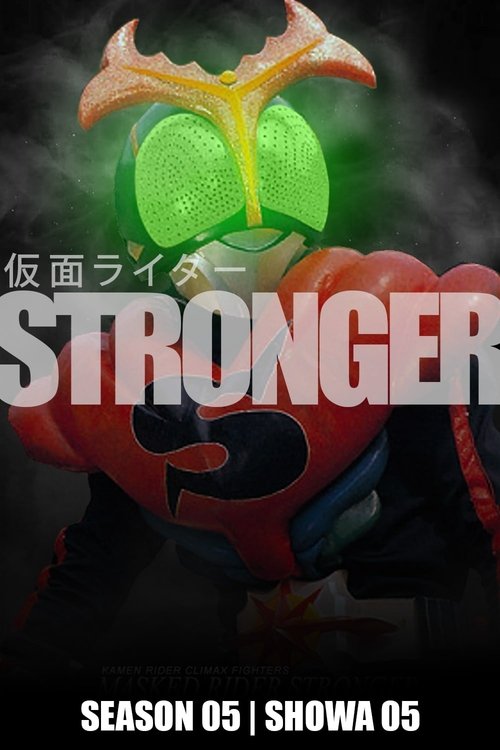
Shigeru Jo joins the evil organization Black Satan after the death of his close friend Goro Numata, who he considered his mentor. He, promised power, and fueled by a desire for revenge, undergoes surgery to become one of Black Satan's super warriors. However, Shigeru knows that Black Satan were in fact the murderers of his friend; he was using Black Satan in order to gain new powers. The newly powered up Shigeru escapes from the Black Satan headquarters before they can brainwash him into following their campaign of evil and becomes Kamen Rider Stronger. While escaping from Black Satan, Stronger meets Yuriko Misaki another cyborg warrior created by Black Satan who has the ability to transform into Electro-Wave Human Tackle. Together they fight the evil Black Satan and later the Delza Army to restore peace in Japan.
Season Review
Categorical Breakdown
The hero, Shigeru Jo, and his allies are judged purely by their capacity and will to fight evil and defend the world. The show is a Japanese production with no discernible 'race-swapping' or 'vilification of whiteness.' The narrative is focused entirely on a universal struggle of meritocracy against tyranny.
The central mission of Kamen Rider Stronger is to 'restore peace in Japan' against a world-conquering organization, Black Satan, and the Delza Army, a race of subterranean beings that wishes to 'retake the surface world.' This frames the hero as a defender of his home and civilization against a fundamental external/internal enemy. It exhibits the defense of established institutions against chaos.
The series introduces Yuriko Misaki (Electro-Wave Human Tackle), a significant early female combatant who fights alongside the hero. She is a competent warrior, but the dynamic maintains Shigeru Jo as the primary, titular, and most powerful hero. Her arc culminates in a dramatic self-sacrifice to protect Stronger, which defines her role as a dedicated sidekick rather than a perfect 'Girl Boss' or a character who emasculates the male lead.
As an action-adventure series from 1975 intended for a broad family audience, the show contains no elements of modern sexual or gender ideology. The focus is on the action, moral conflict, and the protective partnership between the male and female leads. Sexuality is completely absent from the public narrative and there is no deconstruction of normative structures.
The entire conflict rests on an objective moral distinction between good and evil, where the hero fights to ‘defend peace and justice.’ The names of the villains (Black Satan) are used for dramatic effect as an umbrella for world conquest, not as a critique of religion. The hero is defined by his commitment to a higher moral law that champions good and condemns absolute evil.