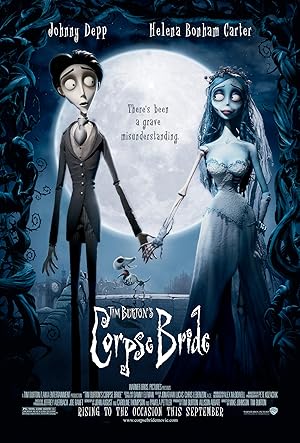
Corpse Bride
Plot
Set back in the late 1800s in a Victorian village, a man and woman by the names of Victor Van Dort and Victoria Everglot are betrothed because the Everglots need the money or else they'll be living on the streets and the Van Dorts want to be high in society. But when things go wrong at the wedding rehearsal, Victor goes into the woods to practice his vows. Just as soon as he gets them right, he finds himself married to Emily, the corpse bride. While Victoria waits on the other side, there's a rich newcomer that may take Victor's place. So two brides, one groom, who will Victor pick?
Overall Series Review
Categorical Breakdown
The characters are all culturally white and the central conflict revolves around class and wealth, not race or immutable characteristics. The antagonist is a white male aristocrat who is revealed to be a murderer, while the protagonist, Victor, is a kind and sensitive white male. There is some cultural commentary surrounding the film's adaptation of a Jewish folktale into a white, Christian Victorian setting, which can be interpreted as 'cultural erasure.'
The Land of the Living, representing Western Victorian civilization, is universally portrayed as bleak, grey, repressed, and corrupt, driven by social climbing and greed. The Land of the Dead is vibrant, colorful, and wholesome, suggesting the ‘other’ realm and its inhabitants are spiritually and morally superior to the home culture.
The female protagonist, Victoria, is delicate and seeks genuine love, adhering to a traditional archetype. The Corpse Bride's emotional resolution involves her choosing independence and vanishing into freedom, effectively liberating herself from the need for a husband after a lifetime of male victimization. This is a subtle promotion of self-sufficiency over a complementary pairing.
The narrative centers entirely on the traditional male-female romantic dynamic and the pursuit of marriage. There is no presence of alternative sexualities, gender ideology, or deconstruction of the nuclear family beyond the negative depiction of the two dysfunctional families attempting an arranged marriage.
The church's representative, the Pastor, is portrayed as an overbearing, judgmental, and authoritarian figure who mocks the protagonist. However, the spiritual world of the dead is a place of justice, color, and moral clarity. The overall spiritual conclusion involves an objective moral law being fulfilled (Emily's murderer is punished, and she finds peace), indicating that a transcendent morality exists outside the organized Church.