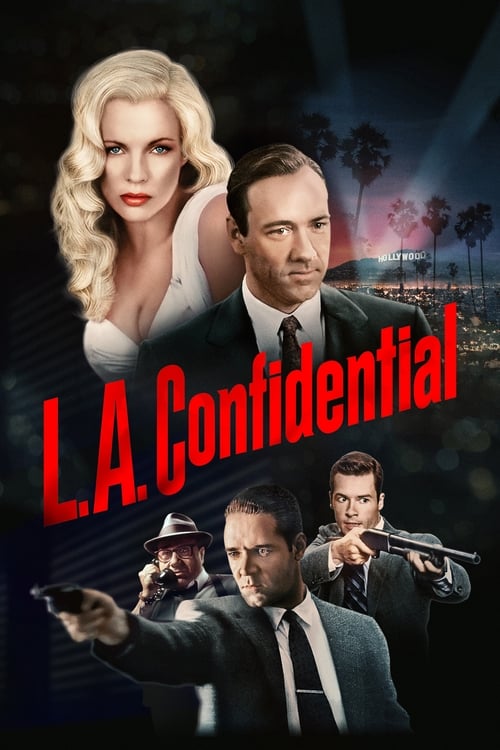
L.A. Confidential
Plot
Three detectives in the corrupt and brutal L.A. police force of the 1950s use differing methods to uncover a conspiracy behind the shotgun slayings of the patrons at an all-night diner.
Overall Series Review
Categorical Breakdown
The plot prominently features the quick framing of minority suspects (young Black men and a separate incident with Latinx men) by the white-dominated police force to create convenient scapegoats and cover up systemic corruption. The main narrative uses this institutional racism and police brutality as a core part of its critique against the white establishment, suggesting the system is fundamentally oppressive.
The film’s central premise is a complete deconstruction and vilification of American institutions in the 1950s, particularly the LAPD and the Hollywood system. It frames the ‘Ozzie and Harriet’ era of American heritage as a sinister mask for systemic rot, violence, and corruption. It displays profound hostility toward the notion of Los Angeles as a ‘City of Angels’ and the sacrifices of the ancestors (the previous generation of police leadership) are shown to be the source of the current chaos.
Female characters are largely defined by the objectification of the noir genre and the era, with the main female lead being a high-class prostitute surgically altered to resemble a film star. She is a powerful 'femme fatale' archetype, but her journey centers on a search for genuine affection outside her commodity status, not on a 'Girl Boss' career narrative. Masculinity is not universally emasculated; instead, the three male protagonists are hyper-masculine, though morally flawed, figures whose individual arcs involve varying degrees of moral redemption and protection.
The presence of alternative sexualities is strictly confined to a single subplot where a gay tryst is orchestrated for a tabloid blackmail scheme. The context is purely exploitation and corruption, accurately reflecting the stigma and illegality of the time. The film does not center a gay character, nor does it feature any lecturing on gender theory or a deconstruction of the nuclear family as a political point; the traditional family unit is simply absent or broken due to the characters' chosen lifestyles or past trauma.
The movie operates within a strong moral vacuum, characteristic of the neo-noir genre, where morality is highly subjective, transactional, and compromised. The protagonists are often driven by utilitarian ends, suggesting moral relativism is the operating principle of the world. However, the film avoids overt anti-theism; it does not portray religious characters as villains or explicitly attack traditional religion. Justice is pursued as a personal, transcendent ideal, even if it requires corrupt methods to achieve.