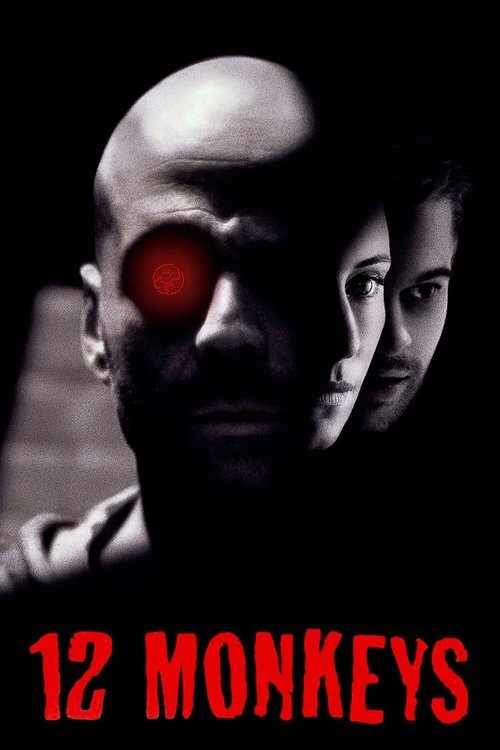
Twelve Monkeys
Plot
In the year 2035, convict James Cole reluctantly volunteers to be sent back in time to discover the origin of a deadly virus that wiped out nearly all of the earth's population and forced the survivors into underground communities. But when Cole is mistakenly sent to 1990 instead of 1996, he's arrested and locked up in a mental hospital. There he meets psychiatrist Dr. Kathryn Railly and the son of a famous virus expert who may hold the key to the Army of the 12 Monkeys; thought to be responsible for unleashing the killer disease.
Overall Series Review
Categorical Breakdown
The narrative is completely detached from identity politics, focusing on universal themes of fate, sanity, and human self-destruction. Characters are defined by their roles in the time-travel mission, their professional competency (scientist, psychiatrist), or their ideological madness (environmental zealot). The casting is entirely colorblind relative to the narrative, with no effort to vilify a specific race or lecture on intersectional hierarchy. The central hero and the core villains are all white males, judged strictly by their actions and philosophical stances.
The film strongly condemns modern, Western, industrial civilization. The disaster that wipes out 99% of humanity is a man-made plague, originating from a nihilistic scientist. The villainous ‘Army of the 12 Monkeys’ is initially thought to be a terrorist cell, but they turn out to be merely radicalized animal rights activists. The true destructive force comes from the scientific establishment itself. James Cole is led to a cynical conclusion that the human race 'deserves to be wiped out,' framing civilization as fundamentally corrupt and self-destructive.
The main female character, Dr. Kathryn Railly, is a competent, professional psychiatrist who uses her intelligence and critical thinking to transition from skeptic to believer, becoming the hero's indispensable partner. Her professional merit is central to the plot’s development. She is not portrayed as a 'Girl Boss' needing to prove superiority by emasculating the male lead; instead, the male lead (Cole) is broken and constantly on the brink of madness, relying on her for validation. There is no overt anti-natalism, as the central relationship is a standard romantic pairing in a world where family is essentially wiped out. Gender roles are distinct but complementary to the mission.
The film contains no themes or characters related to alternative sexualities, gender ideology, or the deconstruction of the nuclear family. The main romantic relationship follows the traditional male-female structure. Sexual identity is a non-factor in the dystopian setting, which is entirely focused on survival, time travel, and psychological breakdown.
There is pronounced hostility toward established modern institutions of moral authority. Dr. Railly explicitly states that psychiatry has become 'the latest religion,' with doctors deciding 'who’s crazy or not,' equating secular power structures with a subjective moral law. The science community, which is trying to save the world, is largely cold, bureaucratic, and manipulative, and their creation (time travel and the eventual cure) is only necessary because of the actions of a nihilistic scientist. The film suggests modern man's hubris (science) is more dangerous than any religious dogma, creating a spiritual vacuum filled by man-made chaos.